Followers

Monday, April 04, 2022

Making all workplaces safer for women


Some measures that can be implemented immediately include sensitising informal sector workers on gender-based violence and informing them in simple language about the laws that deal with such violence


The Female Labour Force Participation Rate, already low in India, received a further setback with the pandemic. Women were the first to lose their jobs once the lockdown was announced, two years ago, and they are yet to get back into the labour force. The female labour force participation rate was at 9.4 per cent for the period between September-December 2021, according to the Centre for Monitoring Indian Economy (CMIE). This is the lowest female labour force participation rate since 2016 when the data was first compiled.

In understanding the all-time low female labour force participation rate, there is a need to factor in a longstanding problem — the safety of women in workplaces. All women deserve a non-discriminatory and safe working space. But those in the informal and unorganised sector deserve particular attention. The pandemic aggravated the situation for women in the informal economy.

The informal economy in India encompasses a variety of activities. The agricultural sector has the highest level of informal employment, followed by manufacturing, trade and construction. In terms of rural-urban differentials, informal employment constituted 96 per cent of total jobs in rural areas, where female informal employment was 98 per cent compared to 95 per cent of male informal employment. Seventy-nine per cent of the jobs in urban India were of an informal nature, with 82 per cent of total female workers engaged in informal employment compared to 78 per cent among urban male workers.

Statistics show that women are more likely to be engaged in the informal sector in both rural and urban areas. They are also more likely than men to be working as informal workers in the formal sector. However, not much has been done in terms of understanding the violence faced by women in the informal sector which can range from harassment to sexual assault and rape. Such violence can be tied up with several aspects ranging from a male-dominated workplace to harassment by labour contractors to a lack of basic amenities for women in the workplace. A few studies also indicate that women in the informal sector face sexual harassment in workplaces.

A recent study by Oxfam India on tea plantation workers reveals that the extremely hierarchical nature of their jobs, the migrant status of workers and the lack of other job opportunities for women tea pluckers contribute to the normalisation of workplace violence. Facilities such as canteens and toilets — generally available in factories where workers are predominantly men — are lacking in the fields. Because of the presence of the mostly male “sardars” (supervisors), women try to seek privacy far away from where their colleagues are working. This makes them vulnerable to sexual abuse or attacks by wild animals. It is now quite well known that women sugarcane cutters undergo forceful hysterectomies. These workers also face domestic violence and verbal, physical, and sexual abuse.

Difficult working conditions are aggravated in the absence of proper redressal mechanisms and women’s access to them. It’s well-known that laws such as the Sexual Harassment of Women at Workplace (Prevention, Prohibition and Redressal) Act 2013, Criminal Amendment Act 2013, and Protection of Women from Domestic Violence Act, 2005 are not implemented well and do not take the difficulties faced by women in the informal sector into account. An effective body for this purpose could have been the Local Complaints Committee structure under the Sexual Harassment of Women at Workplace (Prevention, Prohibition and Redressal) Act 2013, But such bodies are almost non-functional.

The quest for inclusive growth in the post-pandemic should catalyse endeavours to make workplaces in the informal sector safe for women. Some measures that can be implemented immediately include sensitising informal sector workers on gender-based violence and informing them in simple language about the laws that deal with such violence; employers must ensure that complaints committees are functional; sensitising local labour contractors on how to deal with cases of sexual harassment at workplaces. These bare minimum measures can be implemented with technical support from local women’s rights organisations. The government should also step in to improve the implementation of existing laws and increase budgetary provisions for workplace safety.

Written by Ranjana Das

Source: Indian Express, 4/04/21

Time to bid goodbye to AFSPA


It’s only prudent to repeal this Act now. Study its record to strengthen the foundation of Indian democracy


As far back as 1776, Adam Smith in The Wealth of Nations reflected on the harmful effects of laws that “often continue in force long after the end of the circumstances that first gave rise to them and once made them reasonable”. In that passage, however, Smith didn’t consider laws that were not reasonable even in the circumstances in which they were made.

The Armed Forces Special Powers Act (AFSPA) is one such law. Since the full force of this onerous law comes into play only in “disturbed areas”, one must welcome the government’s announcement to reduce the number of such areas. But not to consider the repeal of this anachronistic law, which is now almost as old as the Republic, is a missed opportunity to reflect on why this law has or has not been successful, and to learn from this history and strengthen the foundation of our democracy.

AFSPA allows civilian authorities to call on the armed forces to come to the assistance of civil powers. Once a state — or a part of a state — is declared “disturbed” under this law, the armed forces can make preventive arrests, search premises without warrants, and even shoot and kill civilians. Legal action against those abusing these powers requires the prior approval of the central government — a feature that functions as de facto immunity from prosecution.

A disturbed area proclamation under AFSPA has uncanny similarities with emergencies or states of exception — including martial law and states of siege. Critics charge that it effectively suspends fundamental freedoms and creates a de facto emergency regime.

AFSPA was adopted in 1958 during the early days of the Naga uprising to apply to what was then the state of Assam and the union territory of Manipur. It is hard to believe that to contend with a small group of armed rebels in a remote infrastructure-poor region it was found necessary to have a law modelled on a colonial ordinance devised to tackle the Quit India Movement — the most serious challenge faced by British colonial rule since the rebellion of 1857, as the then Viceroy of India saw it. ThaThe counterinsurgency campaigns against the Nagas were counterproductive. The suffering brought by the forced displacements during village regrouping, for example, only broadened the support for the rebels. Senior government officials who knew the region well soon regretted the way such decisions were made. “It may well be asked how such a ghastly tragedy could have been enacted at all with civilised and intelligent human beings at the helm of the administration,” wrote Nari Rustomji of the Indian Civil Service, who held positions such as the chief secretary of Assam and adviser on tribal areas to the governor. During the Mizo uprising of the 1960s and 1970s what is now the state of Mizoram went through a similar devastating ordeal.

In the following decades, as new states were formed in Northeast India, AFSPA was amended to accommodate the names of those states.

Seven of the region’s eight states have been at the receiving end of AFSPA at one time or another.

Over the past six decades, AFSPA’s use has extended well beyond the actual conduct of counterinsurgency operations. Multiple state and non-state armed actors have operated under its shadow. For instance, in Assam in the 1990s, death squads — or “secret killers” as they were called — carried out a wave of extrajudicial killings. These could not have occurred without the cover provided by AFSPA’s disturbed area designation.

In 2012, the Extra Judicial Execution Victim Families Association of Manipur petitioned the Supreme Court to investigate as many as 1,528 cases of fake encounters that allegedly occurred in the state between 1979 and 2012. The Supreme Court appointed a three-member commission to inquire into the first six of the 1,528 cases in the petition so that it could be “fully satisfied about the truth of the allegations”. None of the small sample of six cases was found to be an actual “encounter”. Drawing on these findings, the Supreme Court bench decided that the allegations could not “be summarily rubbished”. Its interim judgment of July 2016 said that “there is some truth in the allegations, calling for a deeper probe”.

In the court’s view, AFSPA clearly provided the context for these killings. The practice of deploying the armed forces to assist civil power, the ruling stressed, is premised on the assumption that “normalcy would be restored within a reasonable period”. If the civil administration and the armed forces fail to achieve this, that “cannot be a fig leaf for prolonged, permanent or indefinite deployment of the armed forces”. That would be a mockery of “our democratic process” and “a travesty” of the constitutional distribution of powers between the Centre and the states, which provides the legal foundation for the practice.t such a law remains in force till this day does not speak well of our experiment with democracy.

This is not the only time the apex court has been critical of AFSPA. It is often forgotten that when it pronounced AFSPA constitutional in 1997, it also recommended some changes. Among them was the stipulation that a “disturbed area” designation be subjected to review every six months. In some parts of Northeast India, AFSPA is now routinely extended every six months. But there is little evidence that any meaningful review occurs at those times. A statement made by an Assam official in August 2018 when AFSPA was extended in the state for six months is illustrative. “The situation is peaceful,” said the state’s police chief casually, “but we will not take a decision on withdrawing AFSPA till the NRC exercise is over.”

Edmund Burke, a contemporary of Adam Smith, wrote of the circumstances in which the repeal of a law becomes necessary and appropriate. Since “laws, like houses, lean on one another”, he said, repealing a law can be difficult. But when a law’s “transgressions against common right and the ends of just government” are considerable, it is only prudent to abrogate and repeal that law. This is true of AFSPA.

Written by Sanjib Baruah


The writer is professor of Political Studies at Bard College, New York.

Source: Indian Express, 4/04/21


Friday, April 01, 2022

Quote of the Day April 1, 2022


“The pessimist complains about the wind; the optimist expects it to change; the realist adjusts the sails.”
William Arthur Ward
“निराशावादी व्यक्ति पवन के बारे में शिकायत करता है; आशावादी इसका रुख बदलने की आशा करता है; लेकिन यथार्थवादी पाल को अनुकूल बनाता है।”
विलियम आर्थर वार्ड

Current Affairs:March 29, 2022


INDIA

  • State governments have the power to declare linguistic and religious groups as “minorities” in their state if they are lesser in numbers: Centre tells SC
  • BJP’s Pramod Sawant takes oath as Goa CM for 2nd term at Panaji
  • ASI sets expert committee for restoration and preservation of oldest National Flag; was hoisted on 15th August 1947 at St. George Fort in Chennai
  • Lok Sabha passes Constitution (Scheduled Tribes) Order (Amendment) Bill, 2022 for inclusion of Darlong community in list of Tripura
  • BJP’s S. Phangnon Konyak becomes 1st woman from Nagaland to get elected to the Rajya Sabha
  • India renews scholarship for descendants of Bangladesh Liberation War fighters (Muktijoddhas) for five years
  • Chief of Staff of the French Navy Admiral Pierre Vandier visits India
  • Warangal in Telangana to host 2nd leg of Rashtriya Sanskriti Mahotsav 2022 on March 29-30

ET AWARDS

  • Winners of Economic Times Awards for Corporate Excellence 2021 announced
  • Serum Institute of India CEO Adar Poonawalla was Business Leader of the Year
  • Cipla’s executive vice-chairperson Samina Hamied was Businesswoman of the Year
  • Finance minister Nirmala Sitharaman was Business Reformer of the Year
  • Freshworks founder and CEO Girish Mathrubootham won Entrepreneur of the Year award
  • Deloitte CEO Punit Renjen was named Global Indian for the Year
  • Lifetime Achievement Award: Dr Prathap Chandra Reddy, founder of Apollo Hospitals
  • Infosys was declared Company of the Year
  • Laurus Labs was Emerging Company of the Year
  • HCL Technologies was chosen Corporate Citizen of the Year

ECONOMY & CORPORATE

  • Defence Ministry signs contract with Goa Shipyard Limited (GSL) for construction of eight Fast Patrol Vessels for Indian Coast Guard
  • Ministry of Micro, Small and Medium Enterprises (MSME) and the Entrepreneurship Development Institute of India (EDII), Ahmedabad organizing Mega International Summit on MSMEs in New Delhi on March 29-30
  • Horticulture Production in 2020-21 at 334.60 million tonnes; area under cultivation: 27.48 million hectares
  • Petascale Supercomputer Param Shakti inaugurated at IIT Kharagpur under National Supercomputing Mission
  • Joint forum of central trade unions calls nationwide strike on March 28-29 to protest against centre’s policies
  • Sumant Sinha, Founder, Chairman and CEO of ReNew Power, becomes President of ASSOCHAM (Associated Chambers of Commerce and Industry of India)

OSCAR AWARDS

  • 94th Academy Awards presented in Los Angeles
  • ‘CODA’, directed by Sian Heder, won the Best Picture award.
  • Jane Campion won Best Director award for ‘The Power of the Dog’.
  • Will Smith won Best Actor award for ‘King Richard’
  • Jessica Chastain won Best Actress award for ‘The Eyes of Tammy Faye’
  • Best International Feature Film award was won by ‘Drive My Car’ (Japanese), directed by Ryusuke Hamaguchi

WORLD

  • Philippines & US conducting “Balikatan” (shoulder-to-shoulder) military exercises in Philippines

SPORTS

  • Formula One: Red Bull’s Max Verstappen wins Saudi Arabian Grand Prix at Jeddah
  • West Indies (297, 28/0) defeat England (204, 120) in 3rd test at Grenada by 10 wickets to win 3-test series 1-0; first two tests, at Sir Vivian Richards Stadium, Antigua and at Kensington Oval, Barbados, were drawn
  • Thailand’s Nitithorn Thippong wins $500,000 DGC Open golf tournament at Delhi Golf Club course; India’s Ajeetesh Sandhu 2nd
  • Tennis: Poland’s Iga Swiatek wins WTA Miami Open, becomes new women’s World No. 1
  • Sidharth Rawat wins men’s singles title at $15,000 ITF men’s tennis tournament in New Delhi
  • Darshan Singh of Services and Railways’ Varsha Devi win men’s and women’s crowns in 56th National cross-country Championships (10 kms race) in Kohima.

Economic and Political Weekly: Table of Contents


Vol. 57, Issue No. 13, 26 Mar, 2022

Editorials

From the Editor's Desk

From 50 Years Ago

Law and Society

Budget 2022

Book Reviews

Special Articles

Discussion

Perspectives

Current Statistics

Letters

Engage Articles

Study Abroad: Top 3 scholarships offered by Israel to Indian students


Israel, which has emerged as an upcoming study destination for STEM education, is now offering scholarships to meritorious Indian students in all fields.


Israel has come up as one of the most popular study destinations for Indian students, especially for science and medical aspirants, with world-class educational resources and rich history.

The Bloomberg Innovation Index 2020 ranked Israel as the number one for research and development intensity for three years in a row, and that has also contributed to Israel being one of the top choices for Indian students.

Israel has, in recent years, seen some of the best-known professors and top-ranked universities in the world. The country is now aiming at expanding these resources for international students as well, and is promoting opportunities for interested candidates to utilise them and pursue higher studies in Israel. In one such bid, the country is offering scholarships to meritorious Indian students, according to a spokesperson of the education department. Here are the top three scholarships offered by Israel’s education department for Indian students:

Ministry of Foreign Affairs Scholarships

Offered by the government of Israel, these scholarships are available to Indian students applying for M.A., PhD. Post Doctorate or research studies. The scholarship is available for one academic year (October to June) for a maximum of eight months for applicants who hold a BA or BSc degree—or a higher one—and has a good record of academic achievements.

Excellence Fellowship Programme for International Postdoctoral Researchers

Offered by the Council for Higher Education in Israel and the Israel Academy of Sciences and Humanities, this scholarship programme is open for outstanding international postdoctoral researchers. The programme entails a maximum of 20 fellowships to incoming post-doctorates conducting research in one of Israel’s universities. The fellowships are allocated in Sciences, Technology, Engineering and Math (STEM), the Humanities, and the Social Sciences. The fellowships are awarded for two years and students are offered 160,000 NIS (~$47,000) annually. It is open to international candidates who have received a PhD from a recognised higher education institution outside of Israel less than four years from the time of application, or who will receive a PhD from a recognised higher education institution outside of Israel before the commencement of this fellowship.

PhD. Funded by the Planning and Budgeting Committee (PBC), this one-year doctoral programme allows international PhD students of all fields to do research in one of Israel’s top universities as part of their doctoral studies while receiving a generous scholarship. Interested candidates must apply directly to the relevant Israeli university. The annual scholarship is 80,000 NIS for up to one year. International students enrolled in a doctoral degree programme at an accredited institution of higher education overseas, who have completed their first year of doctoral studies can apply for this programme.

In addition to these, several Israeli universities also offer their own scholarships to Indian students, separately for those enrolling in both summer as well as full-time programmes. Interested candidates can contact the university directly at the time of admission.

More information about scholarships and study programmes in Israel can be found on the official website — studyisrael.org.il.Sandwich Fellowship Programme

Written by Deeksha Teri 

Source: Indian Express, 10/03/22


Assam-Meghalaya border: the dispute, and what’s been settled


The chief ministers of Assam and Meghalaya have signed a pact to resolve part of their five-decade-old boundary dispute. What is the root of the conflict? What is the current pact? Who gets what?


On Tuesday (March 29), the chief ministers of Assam and Meghalaya signed a pact in the presence of Union Home Minister Amit Shah to resolve part of their five-decade-old boundary dispute. Over the years, the 884-km border between the two states has witnessed frequent flare-ups.

What is the root of the conflict?

During British rule, undivided Assam included present-day Nagaland, Arunachal Pradesh, Meghalaya and Mizoram. Meghalaya was carved out in 1972, its boundaries demarcated as per the Assam Reorganisation (Meghalaya) Act of 1969, but has held a different interpretation of the border since.

In 2011, the Meghalaya government had identified 12 areas of difference with Assam, spread over approximately 2,700 sq km.

Some of these disputes stem from recommendations made by a 1951 committee headed by then Assam chief minister Gopinath Bordoloi. For example, a 2008 research paper from the Manohar Parrikar Institute for Defence Studies and Analyses refers to the Bordoloi Committee’s recommendation that Blocks I and II of Jaintia Hills (Meghalaya) be transferred to the Mikir Hill (Karbi Anglong) district of Assam,, besides some areas from Meghalaya’s Garo Hills to Goalpara district of Assam. The 1969 Act is based on these recommendations, which Meghalaya rejects, claiming that these areas originally belong to the Khasi–Jaintia Hills. On the other hand, Assam says Meghalaya does not have the requisite documents to prove these areas historically belonged to Meghalaya.

A number of attempts had been made in the past to resolve the boundary dispute. In 1985, under then Assam chief minister Hiteswar Saikia and Meghalaya chief minister Captain W A Sangma, an official committee to resolve the issue was constituted under the former Chief Justice of India Y V Chandrachud. However, a solution was not found.

Key turn but twists ahead

Meghalaya was carved out of Assam in 1972, and has held a different interpretation of the border since. The resolution at six of the 12 areas under dispute is significant, but the remaining points of friction are more complex and may prove to be a bigger challenge.

What is the current pact?

Since July last year, Assam Chief Minister Himanta Biswa Sarma and his Meghalaya counterpart Conrad Sangma have been in talks to solve the long-standing dispute.

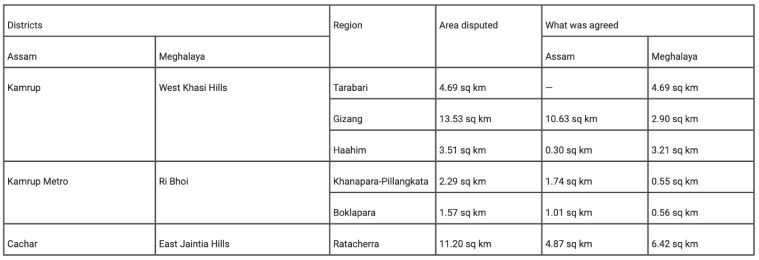
Both state governments identified six out of 12 disputed areas for resolution in the first phase: 3 areas contested between West Khasi Hills district in Meghalaya and Kamrup in Assam, 2 between RiBhoi in Meghalaya and Kamrup-Metro, and 1 between East Jaintia Hills in Meghalaya and Cachar in Assam.

After a series of meetings and visits by teams to the disputed areas, both sides submitted reports based on five mutually agreed principles: historical perspective, ethnicity of local population, contiguity with boundary, peoples’ will and administrative convenience.

A final set of recommendations were made jointly: out of 36.79 sq km of disputed area taken up for settlement in the first phase, Assam would get full control of 18.46 sq km and Meghalaya of 18.33 sq km. The MoU signed on Tuesday was based on these recommendations.

So, who gets what?

From the 2011 claims made by Meghalaya government, an area of roughly 36.79 sq km was taken up for resolution in the first phase.

According to presentations by both states, the area has been roughly divided into equal parts, and a total of 30 sq km is being recommended to be within Meghalaya.

What are the next steps?

The next step will involve delineation and demarcation of the boundary by Survey of India in the presence of representatives of both governments. It will then be put up in Parliament for approval. The process may take a few months.

Officials said six areas taken for study did not have large differences and were easier to resolve, and were hence taken up in the first phase. “The remaining six areas are more complex and may take longer to resolve,” said an Assam government official.

Is there any opposition?

Former Meghalaya CM Mukul Sangma, who is now part of the Trinamool Congress that is the principal opposition party in Meghalaya, criticised the government’s approach. “This is a piecemeal resolution. They have taken up only 36 sq km for resolution. The larger, more complex areas (such as Langpih, Block I and II) are yet to be resolved and it will not be so easy,” he said. “The reality on ground zero is different – as far as I know, many people have not accepted the settlement and the agreement is almost like an imposition,” he said.

In Assam, too, Opposition leaders criticised the state government for rushing through the issues, and not consulting stakeholders. In January, Leader of Opposition Debabrata Saikia of the Congress had alleged that CM Sarma had gone ahead and submitted a proposal to the Union Home Minister “without even a discussion in the State Assembly.” “This is irresponsible and unconstitutional,” said Saikia, asking that the recommendations be rescinded and demanding a special session in the Assembly.

Written by Tora Agarwala ,

Source: Indian Exprss, 1/04/22