Followers

Monday, June 13, 2022

Quote of the Day June 13, 2022


“If you want others to be happy, practice compassion. If you want to be happy, practice compassion.”
Tenzin Gyatso, the 14th Dalai Lama
“यदि आप दूसरों को खुश देखना चाहते हैं तो सहानुभूति को अपनाएं। यदि आप खुश होना चाहते हैं तो सहानुभूति अपनाएं।”
तेंजिन ग्यात्सो, 14वें दलाई लामा

Economic & Poltical Weekly: Table of Contents


Vol. 57, Issue No. 24, 11 Jun, 2022

Perspectives

Book Reviews

Review Article

Editorials

Comment

From the Editor's Desk

From 50 Years Ago

Commentary

Special Articles

Current Statistics

Postscript

Letters

Current Affairs- June 12, 2022


INDIA

– BJP wins 8 out of 16 Rajya Sabha seats in Maharashtra, Karnataka Rajasthan and Haryana; Congress bags five seats
– Nagaland Police frames charges against 30 soldiers over 2021 killing of civilians
– 4 Holy Relics of Lord Buddha from India to be taken to Mongolia for 11-day exposition as part of celebrations of Mongolian Buddha Purnima

ECONOMY & CORPORATE

– FM Nirmala Sitharaman dedicates to nation Dharohar – National Museum of Customs and GST in Goa
– RBL Bank appoints R Subramaniakumar as new MD & CEO
– India extends Sri Lanka $55 mn credit line for fertiliser imports

WORLD

– WTO Ministerial Conference to begin from June 12 in Geneva; Commerce and Industry Minister Piyush Goyal to lead Indian delegation
– Senior Indian diplomat Amandeep Singh Gill appointed by UN chief Antonio Guterres as his Envoy on Technology
– 17 countries elected into UN Economic and Social Council for 3-year term
– United Nations General Assembly (UNGA) adopts India-sponsored resolution on multilingualism that mentions the Hindi language for the first time
– Bangladesh: Women’s Hostel funded by Indian govt inaugurated in Sylhet
– In a first, Canada to require a warning be printed on every cigarette

SPORTS

– Norway’s Magnus Carlsen wins Norway Chess 2022 at Stavanger; India’s Viswanathan Anand is third
– R. Praggnanandhaa wins Norway Chess Group A open chess tournament

Current Affairs- June 13, 2022


INDIA

– J&K ranks highest among UTs in national e-governance service delivery assessment (NeSDA)
– Union Home and Cooperation Minister Amit Shah chairs 25th meeting of the Western Zonal Council meeting at Diu
– Union Home and Cooperation Minister Amit Shah Amit Shah inaugurates memorial museum at decommissioned warship INS Khukri at Diu
– Doordarshan and Doordarshan News Director-General Mayank Kumar Agrawal given additional charge of Prasar Bharati CEO

ECONOMY & CORPORATE

– China’s Tencent buys stake worth $264 million in Flipkart from Binny Bansal
– RTS (Radio Technical Systems) of Russia signs contract with AAI to supply 34 sets of instrument landing system
– New guidelines for celebrity endorsements issued; endorsements must reflect the honest opinions, belief or experience of the endorsers

WORLD

– World Day Against Child Labour celebrated on June 12; theme: “Universal Social Protection to End Child Labour”
– WHO advisory group suggests Huanan seafood market in China’s Wuhan played important role in amplification of Covid-19 pandemic
– New school building inaugurated in Sarlahi, Nepal under grant assistance from India

SPORTS

– Avinash Sable creates new national record of 8:12.48s in men’s 3000m steeplechase
– Manpreet Kaur creates new national record in women’s shot put with a throw of 18.06

Green Open Access Rules 2022

 On June 6, 2022 Union Government has notified the Green Open Access Rules 2022, that will accelerate India’s renewable energy programmes.

What are Green Open Access Rules 2022?

  • These rules are notified to promote generation, purchase and consumption of green energy including the energy generated through waste-to-energy plants.
  • The rules also enable a simplified procedure for open access to green power.
  • They also accelerate the renewable energy programmes, with the aim of ensuring access to affordable, sustainable, reliable, and green energy for all.
  • These rules will help consumes in demanding green power from DISCOMS (power distribution companies).
  • The rules will provide certainty on open access charges, that will be levied on green energy open access consumers.

Green Open Access

According to the rules, green open access is allowed to any consumer. Limit of open access transaction has also been decreased from 1 MW (megawatt) to 100 kW for green energy. This will also enable small consumers to purchase renewable power by means of open access. There will be transparency in approval process of open access applications. According to the rules, approvals are required to be granted in 15 days, otherwise it deemed to have been approved subject. It will be done through a national portal.

Tariff for green energy

Tariff for the green energy will be determined by appropriate commission. It will consist of average pooled power purchase cost of renewable energy, service charges covering prudent cost of distribution licensee and cross-subsidy charges, in order to provide the green energy to the consumers. These rules will streamline overall approval process to grant open access, including improve predictability and timely approval of cash flows for renewable power producers. It will bring uniformity in the application procedure.

Cap on increasing the cross-subsidy surcharge

Rules provides for cap on increasing cross-subsidy surcharges and do away with additional surcharge. It will incentivise the consumers to go green as well addresses the issues pressing the growth of open access in India. Consumers will receive certificates if they consume green power.

Global hunger calls for a collective action

The world system that feeds humankind has been under stress for the past two years. It began with the coronavirus pandemic, which created food insecurity by disrupting agricultural production, supply-chains and livelihoods. The cost of critical inputs for agriculture—energy and fertilizers—rose sharply, as crude oil prices trebled between late 2020 and early 2022. The Russia-Ukraine war strangled crucial sources of supply, as these two countries contribute 28% to world wheat exports and 15% to world maize exports. Exports from Ukraine are simply not possible, as Odessa port is blockaded by Russia and mined by Ukraine, while exports from Russia are squeezed by sanctions. Climate change has accentuated the problem for wheat in 2022. Untimely rains in China, the world’s largest producer of wheat, an unprecedented heat wave in India, the world’s second largest producer of wheat, and insufficient rain in the wheat belts of the US and France, have all reduced output. Drought in the Horn of Africa has severely hurt the production of wheat and maize.

In less than six months, world prices of wheat have risen by 60%. The prospects are worrisome.

Ukraine, ravaged by war, might not be able to store what remains of the harvest to come, or plant for the next season. Russia will inevitably experience constraints. Surging prices of energy, fertilizers and pesticides will either shrink profit margins or diminish their use, reducing agricultural yields and output everywhere, particularly for poor farmers in developing countries. The spectre of a global food shortage looms large on the horizon. In a statement on 18 May, Antonio Guterres, the United Nations’ Secretary General, said that: “Global hunger levels are at a new high. In just two years, the number of severely food insecure people has doubled from 135 million to 276 million." Going further, he warned that the present situation “threatens to tip tens of millions of people over the edge into food insecurity, followed by malnutrition, mass hunger and famine, in a crisis that could last for years."

The availability of food grains for human consumption is constrained not only by output levels, but also by alternative uses. For one, the proportion of grains used to feed animals is alarmingly high. Estimates suggest that 33% of maize produced in the US and 40% of wheat produced by the EU is eaten by cows, while an enormous amount of maize grown in and imported by China is used to feed pigs. For another, a significant, albeit smaller, proportion of grains and vegetable oils are used to make biofuels—ethanol and biodiesel—which drive cars or trucks on roads, even if the objective is to reduce pollution.

There is a deeper structural problem in the world food system. Production and exports are concentrated in 10-12 countries, while consumption and imports of food, more widely distributed, depend on population and income levels. Moreover, a relatively small proportion of world output —25% for wheat and 15% for maize—is exported. It is appropriate to focus on wheat, the most important grain for human consumption, except in Asia, where it is rice.

Eleven countries account for 70% of global wheat production: China and India (the two largest producers) for 31%, Russia and Ukraine for 15%, the US, Canada, France, Germany and Australia for 19%, Turkey and Argentina for 5%. Just ten countries account for 86% of world wheat exports: the US, Canada, France, Australia, Germany and Poland for 50%, Russia and Ukraine for 28%, Argentina and Kazakhstan for 8%. Essentially, rich countries, which also use wheat for animal feed and biofuels, are the exporters. Similarly, just ten countries account for 83% of world imports, but in contrast, all ten are developing countries, listed in descending order of import volumes: Indonesia, Egypt, Turkey, China, Algeria, Bangladesh, Morocco, Nigeria, Brazil and the Philippines. The regions that are dependent on wheat imports for food are North Africa, Sub-Saharan Africa and the Middle East. Most of these countries and regions are vulnerable because Russia and Ukraine provide 25%-75% of their wheat imports.

More than two-thirds of the world’s population lives in countries that are net importers of food, largely in the developing world. The poor in these countries spend at least 40%, if not more, of their income on food. For the poorest, wheat and bread also provide a significant proportion of the calories needed to keep hunger at bay. And, when there are food shortages, it is the poor who go without.

Satyajit Ray’s portrayal of the 1940s Bengal famine in Distant Thunder, or Amartya Sen’s analysis in Poverty and Famines, both show that famine deaths are attributable to paucity of income among the poor rather than food shortages. In the present global context, it will be poor countries that cannot afford to buy scarce food at high prices, and hunger will be the fate of their poor.

Global hunger is a global problem. National actions in isolation, such as export restrictions, cannot suffice. International collective action, motivated by solidarity and implemented through cooperation, is the need of the hour. If the world cannot feed its people, the consequent hunger and starvation will feed conflict by unleashing economic, social and political tensions within countries, which could spill over across national boundaries.

Deepak Nayyar is emeritus professor of economics, Jawaharlal Nehru University, New Delhi

Source; Mintepaper, 10/06/22

Food safety index: how it is worked out, how the states have performed


The SFSI is released annually for a financial year. For instance, the latest SFSI, released on World Food safety Day, June 7, is for the fiscal 2021-22. This is the fourth edition of the SFSI since its inception in 2018-19.


Last week, the Food Safety and Standards Authority of India (FSSAI) released the State Food Safety Index (SFSI) 2021-22. A look at how the index assesses and ranks states, and their performances.

What is the SFSI?

Developed by the FSSAI, the index aims to measure the performance of states and Union Territories on selected “parameters” of food safety. According to the FSSAI, the index is aimed at encouraging states and UTs to “improve their performance and work towards establishing a proper food safety ecosystem in their jurisdiction…”

The SFSI is released annually for a financial year. For instance, the latest SFSI, released on World Food safety Day, June 7, is for the fiscal 2021-22. This is the fourth edition of the SFSI since its inception in 2018-19.

Which are these food safety parameters?

The SFSI takes into account the performance of the states on five key parameters, each of which is assigned a different weightage in the assessment.

HUMAN RESOURCES & INSTITUTIONAL DATA: This carries a weightage of 20% and measures the “availability of human resources like number of Food Safety Officers, Designated Officers facility of adjudications and appellate tribunals, functioning of State/ District level Steering Committees, pendency of cases and their monitoring and participation in Central Advisory Committee meetings of the Food Authority”.

COMPLIANCE: This carries the highest weightage, 30%. “This is the most important parameter and measures overall coverage of food businesses in licensing & registration commensurate with size and population of the State/UTs, special drives and camps organized, yearly increase, promptness and effectiveness in issue of state licenses/ registrations,” the FSSAI says. “Promptness” in attending to consumer grievances, and availability of a help desk and web portals, too, come under this parameter.

FOOD TESTING—INFRASTRUCTURE AND SURVEILLANCE: Weighted at 20%, this measures the “availability of adequate testing infrastructure with trained manpower in the States/ UTs for testing food samples”. The FSSAI says, “The States/ UTs with NABL accredited labs and adequate manpower in the labs score more in this parameter.” It takes into account the “availability and effective utilization” of Mobile Food Testing Labs and registration and utilization of InFoLNet (Indian Food Laboratories Network).

TRAINING & CAPACITY BUILDING: This parameter carries the lowest weightage, at 10%. It measures states’ performance on training and capacity building of regulatory staff.

CONSUMER EMPOWERMENT: This carries a weightage of 20%. It evaluates the states and UTs on their performance on various consumer empowering initiatives of FSSAI, such as participation in Food Fortification, Eat Right Campus, BHOG (Blissful Hygienic Offering to God), Hygiene Rating of Restaurants, Clean Street Food Hubs, etc.

Besides, the states’ initiatives for creating consumer awareness are also considered under this parameter.
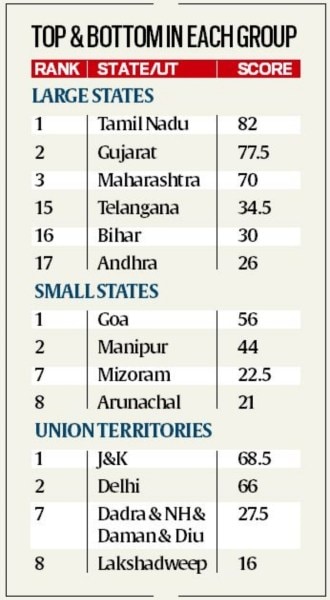
How is the states and UTs assessed?

The states and Union Territories are not assessed and ranked together. They are segregated into three categories — large states, small states and UTs— and assessed separately within their respective categories, based on their performance on the selected food safety parameters.

“The assessment and evaluation of each category are done by separate teams comprising of outside experts for food testing and food & nutrition professionals in addition to FSSAI officials,” the FSSAI says.

These expert teams examine details received from the states and UTs. They also interact with the states/UTs through video-conferencing for verification and confirmation of data.

How have the states and UTs performed this year?

In the category of the 20 large states, Tamil Nadu with an overall score of 82 out of 100 has performed the best and been ranked 1st on SFSI 2021-22, while Andhra Pradesh with an overall score of 26 has been ranked at the bottom —17th place (some states share a common rank).

Following Tamil Nadu in the rankings of the larger states are Gujarat (rank 2nd with a score 77.5), Maharashtra (3rd with 70), Himachal Pradesh (4th with 65.5) and West Bengal and Madhya Pradesh (sharing 5th with a score of 58.5).

Bihar (rank 16th, score 30), Telangana (rank 15th , score 34.5), Assam (rank 14th, score 35) and Chhattisgarh and Haryana (rank 13th, score 38) join Andhra Pradesh in the bottom 5 among the large states on the SFSI for the large states.

Among the remaining 8 large states, Kerala with a score of 57 has been ranked at 6th, Uttarakhand (score 55) at 7th, Odisha and Uttar Pradesh (both 54.5) at 8th, Karnataka (score 52.5) at 9th, Rajasthan (score 50.5) at 10th, Punjab (score 45) at 11th and Jharkhand (41.5) at 12th.

Among the eight small states, Goa with a score of 56 has been ranked at the top, while Arunachal Pradesh (rank 8th and score 21) is at the bottom.

Among the eight Union Territories, Jammu and Kashmir with a score of 68.5 has been ranked 1st and Lakshadweep (score 16) as the bottom. Delhi with a score of 66 has been ranked at 2nd place.

Written by Harikishan Sharma

Source: Indian Express, 13/06/22